JAI cleric Uyun says he has high hopes for this year’s presidential election, predicted to be won by reform-minded and moderate candidate Joko Widodo. “I really hope our next president will uphold the Pancasila [national ideology], the Constitution, Bhineka Tunggal Ika [national motto of ‘Unity in Diversity’],” he says. “If we uphold Pancasila, there will be no more closures of mosques and other houses of worship.
TheJakartaGlobe.com
EVERY night during Ramadan, Enok Juhanah, 63, performs the tarawih, a special prayer only performed during the Islamic holy month, and every night she chooses to do it at her mosque, the Nur Khilafat, in the district of Ciamis, West Java.
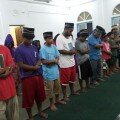
Some two dozen men, women and children have gathered for the same purpose this night, sitting at one side of the small mosque’s terrace, unable to enter the building because it was sealed off by the local government on June 26, just two days before the start of Ramadan.
Unable to perform their prayers inside, the courtyard became the venue of this month’s tarawih for the mosque’s congregation. Although Muslims can and do pray at home, many like Enok choose to pray at the terrace in an act of defiance — sometimes at their own risk.
It was raining cats and dogs on this particular night when the tarawih was performed, the wind blowing bitterly cold; Enok was shivering uncontrollably.
“I feel so sad. This is a house of prayer. Why did [the government] shut it down?” she says after the prayer.
Enok is a member of the Ahmadiyah, a minority Muslim group that has been accused of blasphemy by Sunni Muslims and subjected to countless acts of violence, intimidation and discrimination.
No time for peace
For many Muslims, the holy month of Ramadan is meant to be a time of peace, a chance to sideline earthly worries and focus on the spiritual; but this is hardly the case for Indonesia’s Muslim minority groups like the Ahmadiyah.
“We were banned from performing our prayers inside [the mosque], but the ban doesn’t say anything about the terrace,” says Dadan Andriana, a spokesman for the Ciamis chapter of the Indonesian Ahmadiyah Congregation (JAI).
Dadan says despite the loophole, there is still the risk that hard-line groups, which have long deemed it halal, or permissible in God’s eyes, to shed the blood of Ahmadis, may feel provoked and decide to attack the congregation.
“That is our biggest fear. When we pray, we don’t feel at peace at a time like this,” Dadan says, adding that each night two or three Ahmadiyah men stand guard during the prayers.

A congregation of the minority group praying on the terrace of their sealed-off mosque in Ciamis. (JG Photo/Yuli Krisna)
“In Tasikmalaya, an Ahmadiyah mosque was taken over. In Tolenjeng [another mosque] was burned and destroyed. In Sukapura, they also burned and ransacked [a mosque], and in Banjar they sealed [off a mosque],” he says.
For the Ahmadiyah congregation in Tasikmalaya’s Singaparna subdistrict, performing the tarawih as a group is no longer an option. “Every time we hold a communal prayer like the Friday prayer or Koranic recitals, we are always attacked by a group of people,” says Nanang Ahmad Hidayat, the head of the JAI’s Singaparna chapter.
The local Ahmadiyah mosque was last attacked in June 2007 and since then largely abandoned, with JAI leaders instructing the 500-strong congregation in Singaparna to pray in the safety of their homes. Even the mosque’s Islamic school had to be moved to another village.
For the last seven years, the mosque has only hosted groups of five to 10 people praying at a single time, Nanang says, while the rest perform the tarawih at home or at mushalla, prayer houses.
Rising intolerance
According to the religious freedom advocacy group The Setara Institute, cases of religious intolerance have been on the rise since President Susilo Bambang Yudhoyono took office in 2004. In 2012, the group recorded 371 cases of religious violence, intimidation and discrimination, up from 299 cases in 2011.
The Wahid Institute, another religious freedom advocacy group, recorded a similar increase, from 184 cases of religious violence in 2010 to 274 in 2012.
According to the National Commission on Human Rights (Komnas HAM), there were 20 cases of houses of worship being closed or attacked in 2012, and 17 cases where religious gatherings were attacked or disrupted.
JAI Ciamis spokesman Dadan says his congregation will not buckle without a fight. Since its mosque was sealed off last month, the congregation has repeatedly requested a meeting with Ciamis district head Iing Syam Arifin, but to no avail.
Dadan says the closure has no legal basis. The JAI also questions why the decision was done by “Muspida Plus,” which means a party other than the Muspida (Regional Leadership Board, comprising representatives of the local government, military, police, community and religious groups) was involved.
“We suspect that the Muspida Plus refers to the FPI,” he says, referring to the Islamic Defenders Front, a hard-line group notorious for its attacks on religious minorities such as the Ahmadiyah and the Shiites.
The JAI has also called on Komnas HAM and the Indonesian Ombudsman to weigh in on the closure and demand an explanation from the district chief.
In Wanasigra subdistrict, Tasikmalaya, the local Ahmadiyah congregation feels it is safe enough to hold regular communal tarawih prayers at its mosque. Each night during Ramadan, the Al Fadhal mosque is packed with Ahmadis listening to the pre-prayer sermon and staying on to perform the tarawih.
All 700 people in the village are Ahmadis, the congregation says, providing some security. But worries still linger.
On May 5 last year, the village was attacked by a mob of 150 machete-wielding men, who damaged 24 homes as well as the village’s main mosque.
“What I can’t understand is why the 100 heavily armed, heavily equipped police officers [deployed before the attack] did little to stop these people,” says Syamsul Ma’arif, who was in charge of the village’s security at the time.
For Khairunnisa, a resident, last year’s attack only reaffirmed her faith and emboldened her to pray at the mosque.
“I just leave everything to God. If we are afraid and we don’t go to the mosque, it is our loss,” she says.
Undeterred
Just as unperturbed by threats and the growing hatred toward his community is Hesti Rahardja, a Shiite and chairman of West Java chapter of the Indonesian Ahlul Bait Congregation (Ijabi).
He says the Shiites in Bandung continue to carry out religious activities this Ramadan, including breaking the fast with orphans and the poor, or holding religious discussions, despite several hard-line groups in Bandung forming an Anti-Shia Alliance just two months before Ramadan.
The alliance “doesn’t bother us at all. Usually the more someone is threatened, the better his prayers are,” Hesti says with a smile. “We are fine with people hating us… We respect their right to express themselves. As long as it doesn’t break the law we can’t complain.”

Shiites having a prayer discussion in Bandung, West Java. (JG Photo/Yuli Krisna)
Last November several Shiite groups in Bandung, Surabaya, Makassar, Yogyakarta and Jakarta were harassed as they tried to celebrate Assyura, the Shiite Day of the Martyrs. In Bandung several hard-liners blocked the entrance to a building where the Assyura was scheduled to take place, forcing the local congregation to find another venue.
Hopes for next president
JAI cleric Uyun says he has high hopes for this year’s presidential election, predicted to be won by reform-minded and moderate candidate Joko Widodo.
“I really hope our next president will uphold the Pancasila [national ideology], the Constitution, Bhineka Tunggal Ika [national motto of ‘Unity in Diversity’],” he says. “If we uphold Pancasila, there will be no more closures of mosques and other houses of worship.
“The government should only facilitate, not interfere with people’s beliefs. Deeming someone blasphemous or righteous should be left up to God.”
JAI Ciamis spokesman Dadan says the next president must resolve past cases of rights abuses and religious violence.
“Whoever is elected… human rights violations, specifically against religious freedom, must be resolved clearly. There should be no more people being threatened and intimidated because of their faith. No more houses of worship or mosques closed down,” he says.
_
By Yuli Krisna on 12:25 p.m., Jul 20, 2014
Category Featured, News, Religion
Tags: Ahmadiyah, minority religions
Related posts (berita/tulisan terkait):
 Voting against Indonesia’s religious intolerance
  Ahmadis unequivocal in response to ban by MUI
  SBY’s Pluralist Legacy in Tatters, Survey Confirms
  Belief in One God Indonesia’s next leader must prioritize human rights
  Suasana Ramadan Muslim Ahmadiyah Marshall
  Jemaah Ahmadiyah Ciamis Buka Segel Masjid
  Study blames govt for rising religious intolerance